Showing posts with label goin' medieval. Show all posts

Monday, September 06, 2010

BLOG ALL THE THINGS!!*

My honey made crepes last weekend. By God, I love when that man cooks. When he cooks, I know all is right with the world. He is the creative one in the kitchen, I'm more of a "throw that shit in the oven on 350 for 35 minutes and it's done" type (I do make a mean chocolate chip cookie, though).

We finally got a barbecue this summer, and it is good. See? This was a couple months ago when we put on the first real steak. It was documented for posterity. And beans on the side burner. Because beans are awesome.


Beans and MEAT

He did this impromptu thing on the barbecue last week with the sweet potatoes where he added maple syrup and cinnamon. NOMNOMNOM.

Enough food prøn. Enough of me feeling like a lazy slacker who doesn't know how to work or get shit done. Let's look at the things I've done recently that don't fall into the SUCK category.

My first foray into entrelac, two of these 8x8 squares for group blanket projects.


Malabrigo worsted in the so-obnoxious-you-have-to-love-it "Lime Blue" colourway

I finished knitting the hat that I bought awesome trim for in mid-June, and finally got around to thinking about blocking and finishing it. One problem: it fit fine before blocking, but when I took it out of the water and tried to block it with a balled-up towel, the yarn stretched like crazy, and the hat suddenly ballooned to a size that comes halfway down my face. I now have it drying flat, and spent a lot of time fiddling with it to try and block it back down to the proper size, but I'm not sure I was all that successful. If I have to, I'll frog it and do it again in the smaller size. It's not that difficult a knit. I'm also now wondering if it's maybe worth lining the final hat to help keep its shape in the future. Of course, that involves sewing. *grumblegrumble*


The amazing expanding hat. Yikes. We'll see what I end up with when it's dry, but I'm betting on huuuuuuuge.

The new Liesl cardigan is flying along, surprisingly. I'm almost done with the body. I'm very much enjoying working with the Cascade220 Heathers wool.


Sleeves soon! It's almost like an insta-sweater.

Finally, an Audrey update! I'm hoping to re-start Audrey the Indigo-Sig Vat for her third season of dyeing. She's been sitting outside in her bin all summer during the heat wave, while I've been sweating too much to even think of dealing with her. One would think that I'd try to get her going again when the weather is possibly hot enough to keep her warm naturally, but that would be too easy. Today was a lovely cool day, and I finally had the energy to do what I've been wanting to all summer, namely strain off the liquid into the spare jar and get rid of the inch or so of muck on the bottom before trying to start her up for the season.

Let me lay this out plainly. This afternoon, I spent 30 minutes carefully transferring nearly 2 gallons of very stale, bacteria-ridden, indigo-infused piss from one jar to another, in the process straining out the rotted remains of 3 years worth of dates, plums, bananas and settled-out urine sediment, using a tea strainer and an old teacup. All clear? OK.


Audrey in her natural habitat, surrounded by Morning Glories for company.

The thing that worries me is that... well... she just wasn't very stinky today. I mean, there's smell, but it's nothing like the normal mind-blowing stench I've come to know and... er, love? I don't remember the smell being this tolerable before... unless, Jebus and FSM help me, I'm actually getting used to it. At any rate, I'm not entirely sure if she'll come back this year. We'll see. I checked her pH (between 9-10, which is just right), added some more stale urine (ask not from where it came - it's FOR SCIENCE!!), fed her some mushy bananas, and turned on her heating pad.

After today's handling, she's now thoroughly oxygenated, so it'll be several days before she even starts to settle down, and a good 7-10 days before we can expect her to be dye-worthy. And then I might still have to add some indigo. You can see some of the mushed-up banana floating here:
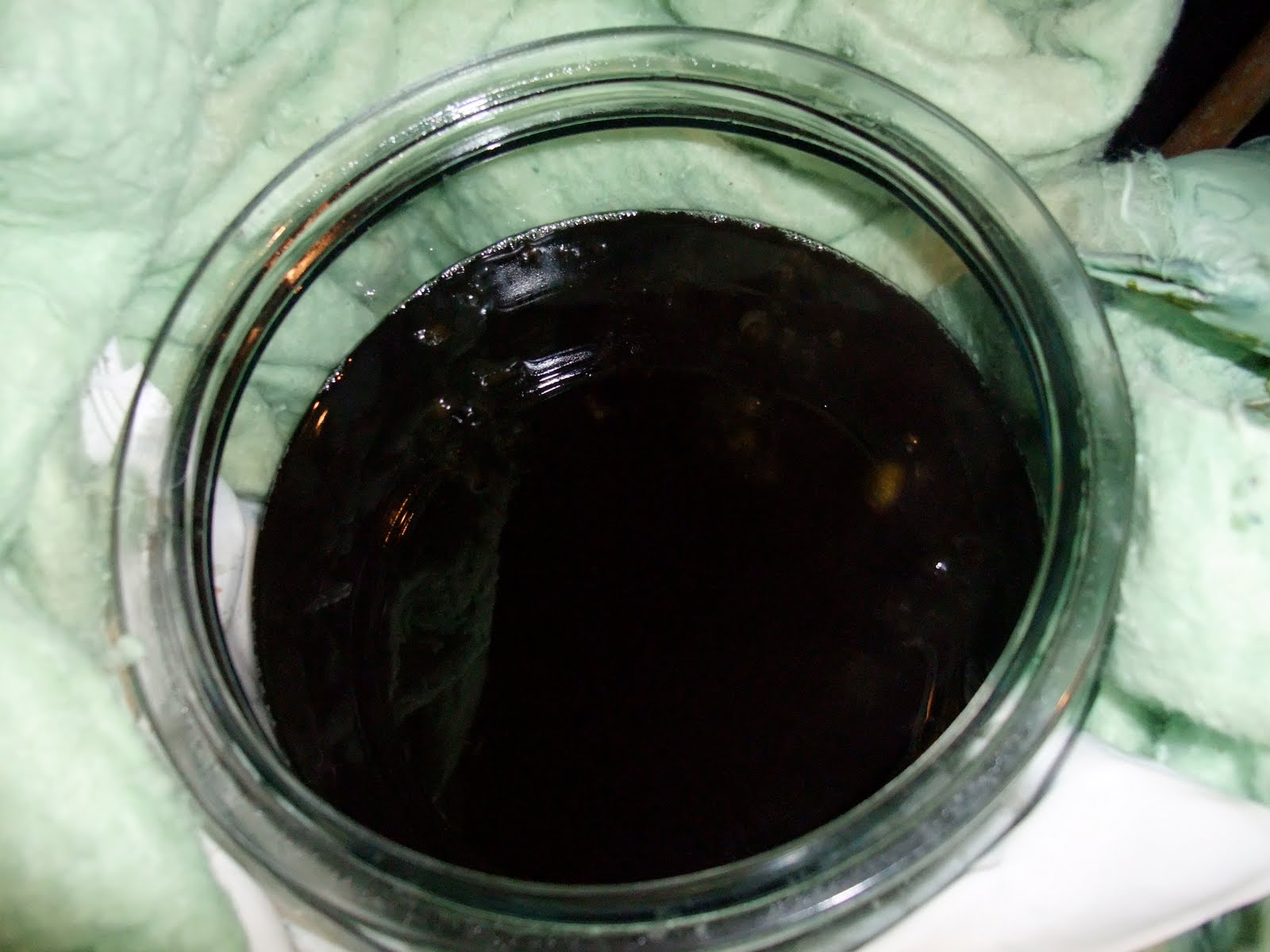

Tucked in for the night. I feel like a nervous Mom. Or perhaps, a nervous mad scientist.

Let's see, we've gone from food to knitting to straining pee. All in a week's work, I'd say. Next post: Pennsic loot.

*Translation here. Read and weep tears of joy and recognition at your own life.

Wednesday, February 04, 2009

The Threads That Bind Us All Together

The new Baronial Pillow was presented to the Baron and Baroness of Septentria this past Saturday at Ealdormere Kingdom 12th Night. I finished weaving the back a couple hours before leaving for the event, having had to replace not one or two, but four broken warp threads the night before.

Four Vest Yorvik ladies, (myself, Eleanor, Aislinne and Violetta), formed an instant sewing circle upon Eleanor's and my arrival at the event at 2pm, and spent most of the afternoon putting the finishing touches on it. We were like a well-oiled, multi-tasking sewing machine. Aislinne, who had created, applied and embroidered the baronial arms on the front with hand-made felt and some of my indigo blue and green hand-dyed drop-spun wool embroidery thread, added two more badges to the front, recently delivered from their respective Cantons. In the meantime, I cut the back off the loom, hem-stitched the edges and pulled out the packing thread. Violetta, who had made the inner stuffed pillow from red linen, added the last of the stuffing to that and sewed it up, then helped me weave in the loose bits on the back. Eleanor held us all together with the passing of pins, scissors and wrangling ends of long fabric.

After Violetta whip-stitched one long side of the top to the bottom, Eleanor and I sewed up the sides and attempted to make the fringe more respectable. With 10 minutes to go before court - we were first on the agenda - Violetta stuffed the inner pillow into it and began to whip stitch the long bottom closed. In a moment of inspiration, Aislinne took the remaining warp thread off my shuttle and skeined it, stuffing it inside along the bottom just before Violetta finished closing it up, so that when it's opened up later for eventual re-stuffing or repair, there is a small repair kit inside. It was finished as court processed into the room.

Unsurprisingly, I don't have pictures of us working, because I was, well, working. I saw some pictures being taken, so if someone else posts them, I'll link.


The new Baronial Kneeling Pillow for the Barony of Septentria, Kingdom of Ealdormere, made by the Canton of Vest Yorvik, bearing the arms of each Canton in the Barony (Skeldergate is still coming!). Finished woven size (before stuffing): 3ft. x 18". It comes with a lifetime guarantee that we will make any necessary repairs.

Just under two years in the making, from shearing to wool prep to dyeing, carding, spinning, weaving, embroidery and finishing. A group project, from start to the very moment of finish, with the participation of not just the four of us who finished it on Saturday, but many others in the canton who helped us procure the fleece, clean it, dye it, and even help me weave a few inches. I personally learned a great deal about dealing with raw fleece, dyeing and weaving during this project.


A little better view of the weaving and Baronial Arms. The canton arms displayed here are: Vest Yorvik (top left), Monadh (bottom left), Eoforwic (top right) and Swan's Keep (bottom right)

And now, I can put something new on my loom. Thank Jeebus.

Also: A closeup of the arms of the Canton of Vest Yorvik, our official part of last year's baronial taxes, where each canton was to create their embroidered arms. Vest Yorvik then had the added privilege of making the pillow to display them all.


Designed and stitched by Aislinne with help from all members of the canton (a few stitches each), using my hand-dyed hand-spun blue, yellow, green, black and natural wool. The red is the same red as the pillow wool.

Thursday, December 04, 2008

I swear I'm not really a dyer, Part 4: The second annual dye madness day (BYOP), and "black enough"

The final installment of this year's dye adventures, at long last. It occurs to me that we have officially been in our house for a year: we closed on Black Friday 2007 (an accident of Realty and Lawyers over which we had little control), and then we spent the next week and a bit moving, a van-load at a time. We had to be out of our old apartment on Dec. 4, 2007. That makes this post appropriate - I guarantee I would never have undertaken most of this year's the dye adventures if we hadn't acquired a basement, a working kitchen, and a backyard!

Audrey the Indigo Vat had a magnificent final outing of the season over the Canadian Thanksgiving long weekend (mid-October), when she was very carefully packed up and transported across town to my friend Helena's house a few days ahead of our annual* Dye Madness day at her house. Helena cared for her and kept her warm, feeding her some de-thawed, mushed up, organic bananas - after the traumatic ride, Audrey was a little gassy and needed to settle down, eat, ferment and reduce for a couple days.

Why not have the dye day at my house? You see, Helena has a magnificent dye garden, and Audrey was more portable than the garden. I requested that folks BYOP**, if they could, so that we would be sure to have enough to pre-soak things. One can only generate so much urine on one's own. In the end, with the help of the others (and also my reluctant but patient husband, who eventually learns to accept the Crazy), we had plenty.

Last year we did cochineal, weld, and madder berries. This year, though, the main plan was to dig up some of Helena's now 3-year-old madder and work with it fresh. The weather was perfect, and nearly room temperature outside - on the second weekend of October! We actually worked up a sweat, attacking the raised beds with gloves, shovel, spade and much glee. We hosed down some huge balls of bright-carrot-orange roots that looked for all the world like strange sea creatures, chopped it up and into the pot it went. We only dug up a little corner of her madder - and there was still plenty for each of us to take some home, and she still has 3/4 of her madder plants growing:


Freshly killed madder roots, drying in my basement

We weren't sure how the madder would go - the one experienced madder dyer in the group had never used it fresh from the ground and chopped roughly. She suspected it wouldn't give us anything too far into the reds or too dark. She was right - we got a nice salmon - but towards the end of the dyebath we did start seeing the reds come out a little. It will be interesting to see what we get later with the roots that we're drying, as those will be ground up more finely.

We also found a bush of Dyer's Broom growing in her garden, so we pruned it back a little and made a small pot of that with alum. We poked it dubiously throughout the afternoon, as the water didn't seem to be getting much colour into it. But after a good 90 minutes of cooking, it finally started to suck colour out of the leaves. We ended up with a nice light greeny-yellow.

Audrey was in fine form for the day, thanks to Helena's kind care and feeding after her rough ride. She performed well, and gave us everything from a medium blue fleece (a 5-hour soak) to some lovely light blues on roving that was only left in an hour or so, to a nice overdye of some patterned tan fabric.

As we were packing up our wet samples, we suddenly realized that we had, without really planning it that way, done the a primary colour set that day:


L - R: Indigo blue, fresh-killed dyer's broom yellow, and fresh-killed madder salmon

And then there was the added bonus: as we were standing around surveying the wonder that is Helena's dye garden, one of the ladies noticed that right next to us, very near the house and suspiciously close to where we had been chopping up weld plants the previous year, were three tall stalks of weld. It appears the seeds took root between cracks in the concrete. Nature is nothing if not persistent. Helena was happy for us to pull it and make it go away, so the lady and I split it.


Surprise weld, the best kind!

All the participants in the festivities agreed that our second annual (BYOP) dye day was a great success, and we all look forward to next year. And if Sharon Ann is reading this, your half of that weld has been packed up and will be in the mail to you soon, I hope (as soon as my mother comes up for a visit, which should be in the next couple weeks, before Christmas).

In other dyeing adventures, I continued my quest for black by once again trying to overdye this unfortunate colour, which I achieved by way of the weld on the left overdyed with Indigo to make the teal in the middle,, then overdyed in a cochineal exhaust bath. I had originally just tried this in a walnut bath with no additive, but there was no noticeable colour change, since the walnut bath would only add a nice brown to it.

This time, I bit the bullet and added a touch of iron powder to the dyebath. The smell was not as horrifically rotten-egg-like as I anticipated, but it certainly wasn't great. This time, though, I was very careful not to inhale deeply while standing over the pot, and often held a wet towel over my face when I was near it.

Liles (1990: 184-5) recommends an oxalic acid mordanting prior to the walnut-iron dyebath for a good black, but I didn't have a ready source of oxalic acid unless I wanted to buy over a pound of it, so I just went with the iron. I spun up a couple yards of it for my friend to finish the embroidery project that we needed it for:


Not-Quite-Black-But-Black-Enough!

So there we have it. Bridget's 2008 adventures in dying.

And just in case you forgot: I'm not really a dyer. We swears, precious. We swears.


* Two years in a row makes it annual, right?

** P = Pee

Wednesday, November 19, 2008

Whoever coined the phrase "warp speed" apparently didn't have cats

So. I warped the loom. Again. After the unfortunate incident with the red warp yarn that we dyed, I picked up five balls of lovely, red, strong DK-weight alpaca.*


I warped this up the weekend before last onto a 10 dpi heddle and wove a few inches, only to realize that the loom was assembled wrong. This bugged me something fierce, so I took the warp off, fixed the loom, re-tied it and wove about five inches that Sunday night.

Monday I looked at the resulting fabric with a critical eye. The fabric was coming out a little too airy, and was not going to be as weft-faced as we want it. Since the weft yarn is our group's cochineal hand-dyed handspun from raw fleece, we want it to be prominent.

So, I took the whole warp off last Tuesday, and Wednesday night I re-warped it onto an 8 dpi heddle. I was all set to have DH help me wind it onto the loom that night, but that was not to be:


The union stages a sit-in.


Negotiations commence: Whose need is greater?


Negotiations are concluded for the evening.

In the interest of not interrupting an obviously necessary nap time, we wound it on early the next morning, before he left for work (DH is a very good assistant warp-winder-oner, no matter how much he doth protest), and I tied it up Thursday afternoon. I spent much of last Saturday sitting behind a table collecting entrance fees from people for an SCA event.


A knitted SCA combined Arts & Sciences badge. Made quickly a couple weeks ago at the request of the event head cook, to her specifications, to be used as part of a serving presentation during the feast.

During the afternoon dead time at the event, after everyone who was coming had shown up but before we could officially close down the gate, I got in some good weaving time, and had help from at least three others. In the spirit of a truly group project, I'd like anyone who wants to weave a few rows to get a chance, so I taught a few new weavers as well, and Sunday I did some more at home.


Who's happy? That would be me.

It's coming out beautifully. The natural variegation of our handspun wool shows well, and the little bit of warp that shows adds just enough red to brighten it up.


Qapla'

From the first 79 foot skein of weft yarn, we have well over a foot of fabric, 18.5" wide. We're getting 9.5 rows of weft to the inch. We need a little over six feet of fabric - two 3-foot pieces - and then it goes off to others for embroidery and finishing.

And as I finally finish this post and check the date, I realize that it is officially our 14th wedding anniversary. Happy anniversary, love.


* Which begs the question, from a historical re-enactment standpoint, can alpaca yarn be considered within the SCA period we're aiming for, i.e. loosely pre-1600 (1650-at-the-latest) Europe? The answer is, maybe. Alpacas are a South American animal, domesticated there for thousands of years. The Spanish were slaughtering conquering the Incas in the 1500s, meaning they would certainly have had access to alpaca. But did the European conquerers actually use alpaca? Um, probably not. Rather, the Spanish brought in their own herd animals, and it's possible that nearly 90% of alpacas were wiped out during the Conquest, the rest being saved by the natives who took them up into the inhospitable higher altitudes. All modern alpacas come from these surviving herds. Alpaca wool was not really used in Europe until the 19th century. (Note: please don't use me or these random web pages as a reliable scholarly source!)**

** All of which begs the further question - Do I care?***

*** Which brings us to the answer: Nope. I have warp yarn of the right weight and colour that will not break on me. It is not synthetic, and is in fact from an animal that was domesticated well before 1600 and known by Europeans at that time, even if they were too dense to bother using alpaca for fibre. Blows raspberry in the general direction of any authenticity police.

Tuesday, October 28, 2008

I swear I'm not really a dyer, Part 3: Onion skins, and What the heck has she been doing all this for, anyhow?

Apparently, 'tis the season to wind yarn off the spindles, ply and make skeins. Over the last several weeks I've skeined a surprising amount of yarn.

For a friend who is doing a special cross-stitch project using only my naturally-dyed handspun:
- 10 yards single-ply of the green I made by overdyeing some (purchased) onion skin/tin yellow roving in the indigo vat.
- 25 yards single-ply of weld-dyed yellow.
- 20-25? yards of single-ply white (undyed) DorsetX.
- 20-25? yards of single-ply deep blue indigo-dyed DorsetX.


She is still using the white and blue, but will give me back what she doesn't use

This weld yellow was too light for the piece - it looked nearly white next to the dark blue - so I combed out some white DorsetX rovings and did a small onion skin with alum+tin dyepot last weekend in order to try and replicate that deep orangey-yellow of the roving I bought from Brush Creek Wool Works in August. In a fit of impatient insanity, I cooked it on my kitchen stove without a face mask, inhaling a little too much heavy metal tin fumes, so I had a sore throat the next day. This is the project that I also need to make black for. I'm still working on that, but it will require cooking wool in iron sulfate. That is definitely an outside project. Just say no to heavy metal poisoning.

But Holy Crap, did I ever get yellow. It is sunglasses-worthy yellow. I left some in the tin afterbath a little longer (like, 20 minutes instead of 10) and also got some that's slightly oranger:


Someone suggested I name it "I lost years of my life so you can have this Yellow." Done.

Also, for yuks, I took some of the accidental teal that I made when I put the light weld-yellow into the indigo vat for too long, and threw it into the onion skin/alum+tin exhaust bath to see if I could bring it back down to green and replicate what I made with the purchased bright yellow roving:


Woohoo!

Also, I andean-plied a whack of 2-ply yarn to go to another friend for a different (but not unrelated) special embroidery project:


- 28 yards (56 single-ply) of the overdyed green.
- 8 yards (16 single-ply) of the deep blue indigo DorsetX.
- 48 yards (96 single-ply) of white (undyed) DorsetX.

And then there are the other things I've taken off the spindles, all in the last couple weeks:


- 103 yards more of the black superwash merino/tussah silk blend that I want to make into a lace shrug. Total so far: 461 yards. I'll definitely have 600 yards of singles once I finish this last batt.
- 148 yards of a light blue merino that I bought ages ago from Lettuce Knit - I think it was leftovers from one of their spinning classes, so it was probably dyed by Laura (Cosmic Pluto). I bought at least 200 grams, and have not even spun a quarter of it. I'm going to have several large skeins of this stuff. No plans for it yet, though.
- 18 yards of raspberry/pinkish cochineal, the resulting rolag of an early carding test on the first two batches of cochineal-dyed wool. This is all I have of this, it will probably remain a keepsake skein.
-163 yards of light green probably-merino (Eucalyptus/tin) bought at Pennsic in '06. Also no plans yet.

Yikes! That's a lot of spinning, plying and skeins for someone who doesn't have a wheel. And now I have a whole bunch of empty spindles. Whatever will I do?

Oh, I'll think of something.


A bouquet of spindles in their natural habitat

Friday, October 03, 2008

I swear I'm not really a dyer, Part 2: Walnuts and Cochineal

September through November is absolutely my favourite season of the year. The weather is comfy, light jacket weather - not too hot and not too cold. The air smells fresh and crisp, not filled with the pollen of spring or thick humidity of summer. The apple trees are loaded down. The leaves are starting to fall, and they smell divine as they make that crunching noise under my feet.


My neighbour's late summer-early fall flowers are incidious, the morning glories particularly so. While the yellow daisy-like things are perfectly happy spreading their sunny goodness into my yard just enough but not too much, the morning glories have long since scaled the fence and are now happily wrapping themselves around my pine trees, air conditioner, the yellow flowers, the drains... whatever they can reach. They're so lovely, I don't have the heart to evict them.

Last Monday, I think I finally figured out cochineal. We dyed the warp for the not-so-super-secret project using Lilies (1990: 132-33) modern cochineal scarlet recipe, and got the red we've been looking for all summer. Holy Crap, is it ever stunning. We got close to this with the last batch a few months ago, but that was using washed-but-otherwise-unprepped wool. There was undoubtably still some lanolin in it, which explains why sections of it came out very light, where the dye barely penetrated. This warp yarn is a commercially-prepared Shetland, probably chemically scoured and bleached. It sucked up the dye like a vampire.

In the meantime, another lady has been spinning up the weft yarn from the three batches we did over the last year, while still others keep her supplied with rolags. She gave me the first couple skeins, freshly plied. So here is our warp (bottom) and weft (top) for the not-so-super-secret-project (a pillow, 18" x 3ft):


Once I get the lozenge twill samples off my loom (need to finish weaving those! ack! only a couple more...), I can start doing tests with this. The final fabric will be weft-faced, since the weft is spinning up nearly twice as thick as the warp. That's fine with me - I have to wonder if the lighter, bluer-red colour of our weft yarn isn't close to what a pre-1600's European dyer would have gotten with cochineal, using alum or light acid solutions (vinegar, fruit juices), before the mid-1600's discovery of using tin to produce a brilliant red.

So the short story: if you're dying fleece with cochineal and you want that amazing scarlet, make sure there is not a trace of lanolin in the fleece. Wash it like you have never washed a fleece before. If you don't want to dye spun yarn, at least prep it into rovings, and dye those.

I tried a black walnut dyebath last night. I need a tiny bit of black for The Project, no more than a few yards. I took a handful of the teal, which was originally white Dorset dyed with weld, then put into the indigo vat for six hours. We put some of this into the last cochineal exhaust bath and got the following, which I guess I can say with authority is a colour found in nature:


Honestly, what colour is that?

I then put that into a "tea" of crushed black walnut husks that have been sitting in water for a week.


Not for drinking

I also added a couple locks of the dark blue. Lilies (1990: 184-85, 29) recommends mordanting with oxalic acid and ferrous (iron) sulfate to get a good black overdye with black walnuts. I do have powdered iron sulfate here, but neither DH or I relished the idea of the house smelling like rotten eggs last night, and I don't have oxalic acid.

After an hour in the dyebath, neither batch of wool was an acceptable black. I'm going to let them soak in the pot for a couple days, but I suspect the iron-oxalic acid thing is in my future. Examples that I've seen of unmordanted, black walnut-dyed wool are usually lovely golden browns, so I'm not surprised that we're not there yet. I have lots of black walnut soup, though, no worries.

The indigo vat, whose name is officially Audrey (as in, "Feed me, Seymour!"), has been fed several mushed-up bananas and a fresh dose of stale urine, and the heating pad is now on, since our night-time temps are going down to single digits. I'll add 1/4 oz. more indigo tomorrow, and hopefully a few days with the heating pad will get the fermentation going again for reducing more indigo. Audrey has a date with some friends of mine in a little over a week.

Friday, September 26, 2008

I swear I'm not really a dyer, Part 1: Indigo, and Battling the Squirrels for Walnuts

Here is what the indigo vat looks like with things soaking in it. It is still going, with the aid of the heating pad and not-yet-freezing temps. I will feed it next week (probably some store-bought plums - our tree is finished for the season, but my vat really liked the plums), and then pack it off to a brave friend's house where it will sit and be cared for until our mid-October BYOP* Dye Madness Day.


I'll have to get a picture of the scarf once I've washed it out. It came out stunning.

In the meantime, I've been spinning some of my indigo-dyed fleece into a weight hopefully appropriate for cross-stitch in single ply, and satin-stitch embroidery in two-ply.


Indigo blue with a creamy white Dorset filling!

I've picked up some walnuts from the ground, but it looks like I missed most of them when they first fell. They're no longer green and ripe, but black. I certainly wouldn't eat the nuts from these - they sat on the ground in the rain for days and started to go a little moldy - but I've been told I can still use the husks for dying, so I picked them up anyhow.

The squirrels got all the good ones, believe me. If it's green and still lying on the ground and the squirrels haven't taken it, it's bad and already has bugs in it. They know these things. They've been kind enough to leave small piles of walnut husks on the stones and chair, so I've collected some of that, too. It's all currently soaking in water to make a brown "tea" for dyeing. I need a little bit of black, so I plan to overdye a handful of the teal.

Every time I go near the walnut tree, a voice above my head starts chattering and cursing at me in ... squirrel. Of course, I could probably score half a ton of good walnuts if I broke into their stash inside my front awning. They should admire my restraint.

Coming in Part 2 this weekend: Walnut experiments and the last cochineal dyebath.


*Bring Your Own Pee

Friday, September 12, 2008

The frog has a point

Since I got a medium blue colour on white wool after a single six-hour dip in the indigo vat, I put in half of the weld-dyed yellow from last September. Six hours later, I had a lovely deep teal. I let the vat rest for a couple days to re-ferment and reduce some more, then I tried a little more of the weld yellow, this time only dipping it for a minute or so. Again, no luck, it came out a light blue. Not even teal, that time.


Left: Weld yellow before going in the vat.
Centre: Weld yellow after six hours in the vat.
Right:
Weld yellow after a minute in the vat.
Obviously, not the greens we're looking for.


Between attempts with the weld, I also tried a different approach, carding together some of the dark blue with a tuft of a friend's yellow roving (I think that was also weld), and spinning it. The result was... greenish? Maybe if I squint, it will look more green. Nope, not going to work.

Sigh.


Not the best video quality, but my favourite performance.

It's become clear that it doesn't take much time in the indigo vat to overwhelm my weld-dyed yellow. Re-reading Lilies, he recommends that greens using indigo+yellow be dyed by doing the indigo first, then mordanting the wool and overdyeing with a good yellow dye. I was beginning to fear that I would have to make time for a yellow dyebath before the weather turns, in addition to the final cochineal batch that I need to do sometime this coming week. But did I mention we have to card out all that cochineal red so that another lady can spin it later this month? And once it's spun, it goes on my loom to make a pillow, hopefully woven by November, so that someone else will have time to sew it together and embroider it in December using the blue, green and white that I'm spinning by hand? And everything has to be done in early January?

And, um, let's not forget that I have real work that I'm supposed to eventually be getting back to. Soon.

Right then. I don't exactly have tons of time here to experiment with with yellow overdyes on my blues to get a nice leafy green. A friend has a bagful of onion skins for me, but I've never dyed with them, and if there's one thing about my dye experiments that I do know, it's that they never, ever come out exactly right the first time, especially when I really need it. I expect I'll end up with orange on my first onion skin dyebath.

In a last-minute desperate move, I pulled off a little piece of that stunningly bright (almost heading toward orange) tin-mordanted onion-skin yellow that I bought from Brush Creek Wool Works at Pennsic. Four quick dips, each less than a minute, gently swish it around a little, air it out for 5-10 minutes in between. Quick vinegar rinse. Wash in warm soapy water. And suddenly...


What I started with, and what I ended with.

...the goal no longer seems quite so far away. I separated out half of the roving and went to town. It's now drying in the basement. If I have time later this month in between everything else, I'll try the onion skins with tin myself. I might even get a chance at another weld dyebath in early October, but what I dyed today will be more than enough green. And even though I didn't do the yellow, I know who did and how, and I can live with that.

As a wise frog reminded me today:
I'm green, and it'll do fine. It's beautiful. And I think it's what I want to be.

Thursday, September 04, 2008

Never saw the sun shining so bright...

...never saw things going so right.


In front, single dip, six hours in the indigo vat. Behind it, three minute-long dips.


And this is the rest of the six hour batch after 12 more hours in the vat

The vat is now resting in order to ferment a little more and re-reduce, in preparation for its weekend date with some weld-dyed yellow.

On to the green.

Thursday, August 14, 2008

The grass and sunlight are woven in for free

I'm home from Pennsic. This year I camped in a new location with a different group. (I-79 side of the Serengetti rather than on Runestone Hill). Being with a small group was quite a bit different compared to the 40+ people in my encampment last year, but I did miss the other group a little. Our encampment was so quiet. Well, OK, quiet in some ways. I haven't completely passed judgement on the location, but I could definitely have done without the almost constant air horns and jack brakes from the highway.

However, it was nicely flat (a bonus, seriously), shockingly convenient to the merchants, main food court and A&S tents, and I did not miss climbing the steep part of the hill every day. I did miss the sound of drums coming up from the lake all night long, though, and the feeling of being more at the centre of things. I'll have to wait a couple months until it's in long-term memory before I decide if I liked the good parts of it enough to camp over there again.


This was taken shortly before tear-down, so the camp fence and lanterns are already gone.

I played in a very excellent pickup dance band from Sunday through Tuesday. I'm still not a spectacular recorder player, but I'm starting to be able to hold my own on melody and play most things up to speed, which makes me happy. I still need a lot of work on recorder, though.

At heart, I suspect I'll always be a brass player. I believe I want need a sackbut. Possibly before the natural horn. Some day.

I was pretty good about not buying too much. I did have to pick up the obligatory spindle:


Yes, it's a heart. Yes, the pink felt baggie came with it. It would make me sick if it weren't so darn pretty.

...and the traditional couple of bags of naturally-dyed roving from Brush Creek Wool Works.


I had to get the red. Their cochineal red with tin mordant is almost exactly the colour we got. In fact, these were the reddest bags of the batch - the rest of her selection were noticeably lighter. I suspect the evenness of her colour compared to ours is because she dyes rovings, not raw fleece of questionable cleanliness. Her cochineal with alum mordant roving was close to our raspberry batch. It makes me feel considerably better to know we got what the pros get with our cochineal dyebaths. Oh, and that yellow? Onion skins with tin. Really, how awesome is that? Onions are the new neon.

I also picked up a pretty thing for my hair, a tiny hard leather pouch, two small handbound leather journals (with handmade paper! and refillable! one for me and one for Daniel to use as a sketchbook), some herbs for a friend and tea and honey - nothing to break the bank. No looms this year, thanks, and I even passed up on the expensive but lovely closed-toe shoes. I walked past the harps and sighed.

Once again, Dread Viscountess Seelie offered rigid heddle weaving classes, so a lot of my second week was spent weaving and generally playing with string. This year we were re-creating several specific archaeological textiles on the rigid heddle loom, using the multiple-heddle technique she taught last year. A few of us offered up our looms as teaching looms, so in all we had five looms going with different warps. We all wove a few inches on each pattern. All designs were woven on standard 20" Beka SG-20 rigid heddle looms, using either two or three heddles as required (3 or 4-shaft patterns), and no pickup sticks.

First a 1-2 Rippenkoper. This is a three-shaft design, requiring only two heddles. Basically, it switches between a 2-1 twill and a 1-2 twill, weft-faced to warp-faced, and also reverses.


Next, a rosette twill. This is 4-shaft design, done using three heddles.


I think this might actually be the back, but I like this side better.

And finally, my absolute favourite, the Jorvik 1336 (i.e. "Coppergate") textile. A honeycomb, or wabengawebe with a twill. I messed up the pattern more than once, being highly distractible on a good day, even more so there. A couple times I only did one repeat of the pattern, and once I did three. But I definitely want to make some long pieces of this one and do something with them.


Front of an apron dress, perhaps? Hmmm.

There was also a loom with a standard 4-harness twill warp, but since I did the twills and double-weaves last year, I didn't do more of those. One of the looms had to go back with its person early and we ran out of time, and since I was planning to put that very warp onto my loom at home, I was asked if I could weave up 5-6 samples to send off to the instructor and others in the class. It's definitely no hardship! I'm learning a lot, and getting the warping experience I was looking for.

So, now on my loom and weaving up nicely, a 2-1 Lozenge. This one is another three-shaft pattern, so it only requires two heddles.


Sample one of five. Or maybe six.

There really is something to be said for sitting under a sun shade, warping looms with a group of women, chatting with the person across from you, muttering the count of the warp thread quietly between sentences... "Here's the three. So, did you guys get wet last night? No, I was very dry - two fours coming through - but it was freaking cold when I woke up at three in the morning. Is that sixteen? OK, tie that off."

Someone might have caught a video of Seelie weaving in one of the classes, in which case I'll definitely post a link. Most of the drafts for these patterns can be found at the complex weavers medieval textiles study group, in the section on the textiles discussed in Lise Bender Jorgensen's book. The Coppergate textile draft is from Thora Sharptooth's site.

Aside from the RH weaving, I didn't take too many classes - one exception being a viking wire weaving class. I got to make a necklace, and wire-wrap a bead. I need to finish it with a hook for it to be completely done - but the part where you pull it through the drawplate is so much fun. It's like magic.


What do mean you don't go to Pennsic to weave?

I leave you with this. It was visible from Currie Road, near the west gate.


Everyone goes to Pennsic, didn't you know?

Tuesday, July 08, 2008

Seeing red. Finally.

Some friends and I are seeing red. We have been dyeing with cochineal, repeatedly, and with mixed success. I don't think we quite have this cochineal thing down yet, but we're getting better. Um, maybe.

The goal: Enough red wool to spin 1400 yards of singles in a good, strong scarlet, to then ply into 700 yards of 8-12 wpi yarn for the weft thread of a not-really-super-secret-anymore-but-I'm-still-not-advertising project that will be woven on my rigid heddle loom later this year. Since we can get a good 500 yards of singles out of a pound of raw fleece, that's 3 pounds of wool to be dyed. We have to do it in 1-pound batches, which has advantages and disadvantages.

We've done four, yes four, batches of cochineal since last October. Below, from L to R, are batch 2, 3 and 4 drying in my friend's pine trees. I don't have a picture of the first pound, which we did last fall, but for that first attempt we used alum-mordanted wool and a dash of tin added mid-dye to the cochineal bath. Half of that batch had previously been dyed slightly yellow with spinach, the rest not. The spinach portion is a little nicer, but both came out a beautiful scarlet, nicer than even the rightmost (closest) batch here.


Christmas in July? The colours are a little more neon pink here than in-person

As you can see, our dye batches are varying in colour dramatically. We won't be using batch 2, the furthest left, because, ugh. It was our first attempt at tin-mordanted cochineal, which is supposed to give the best scarlets. We tried a version of Lilies cochineal scarlet #1 recipe (Lilies 1990: 131-2), and it was going flame orange. When we added the recommended alum, perhaps not as "carefully" as recommended, the dyebath turned a mucky brown, and the wool a dirty, blue-red.

That experience scared us off the tin a little, so we returned to the alum mordanting for batch three. That's middle batch, above, which came out more raspberry than scarlet. The right batch, dyebath #4, is scarlet (despite this picture showing as bright pink), but lighter than we want, because the dye didn't take to parts of the fleece (perhaps it wasn't scoured enough? Hmmm.).

I pulled a couple sample tufts out of batch 3 and 4 to try a test spin after they dried.


L (batch 3) alum-mordanted cochineal, with 1/2 oz. tin and a dash of tumeric (for yellow) added late in the bath. R (batch 4): Tin and cochineal, one-pot method (Lilies 1990: 132-33), with probably a touch of alum from the previous dyebath still hanging around on the pot and stir-stick

In total, we have a pound of deep raspberry and two pounds of light-mid scarlet that are usable. The plan is to blend together the different dye batches when carding it to get a colour something between both. The two test tufts above give this:


Still not quite the red we're looking for, but this is a 50-50 blend of raspberry and scarlet, and I think we'll be blending it more 33-67% in the end

We'll also need warp thread. I've made the decision, after much deliberation and agonizing, that our handspun DorsetX is simply not going to be suitable to use as warp thread for this project - at least, not the way we'll be spinning it. It will mostly be prepped using cards, not combs (necessary because several people are involved, and handcards are the more common item amongst them), giving a woollen, not worsted yarn. This will make a fuzzy, sticky warp. I also can't confirm that the 2-ply will be strong enough for warp, even on a rigid heddle loom. The test singles definitely weren't.

So in late August, we'll be dyeing another 900 yards of white commercial yarn with cochineal for the warp. It might or might not work: varying colour is one thing when we'll be carding together the different dye batches. But when we dye the skeins, they have to be the colour we want, the first time. Precedent says that we simply don't have that kind of control over the cochineal. So, we'll try it, and if it doesn't work, we'll buy a cone of scarlet warp thread.

In preparation for a weaving frenzy this fall, I've warped up the loom to get some badly needed weaving practice. It seemed a good way to use up the Brown Sheep Cotton Fleece that's been in my stash for years:


The necessities for warping a loom: loom, yarn, coffee, chocolate and yarn tangling wrangling assisstant.

Finally, an indigo vat update. Throughout the unseasonably cool and wet Southern Ontario June, no fermentation has been detected in my vat, although it's still mighty stinky. After consulting with an experienced vat-maker, our guess is that although we had a couple weeks of toasty warm temps in early-mid June, the evening temps around here still go down to 14-17C (in the 50s-60sF), which is causing the vat to cool off too much in the evening and is preventing fermentation. The recommended solution (since I lack a 24/7 firepit):


A double-boiler setup using a fishtank heater. Interesting note: fishtank heaters, even saltwater ones, are not rated for urine, and putting the heater directly into the vat would kill it in short order. Hence the double-boiler. Thank you SharonAnn for that hard-won bit of wisdom, and for being a great indigo vat consultant.

After a couple weeks of this, and several consistent warm and sunny days out of the last seven lacking light rain, thunderstorms and hail, I am starting to smell the unmistakable - and surprisingly pleasant - barnyard-like smell of fermentation under the ever-present stench of stale urine. It's still far from ready, and I'm not entirely convinced that the heater, which has a max temp of 85F (something about not wanting to cook fish?), is warming up the water as much as it needs to be to really encourage things to grow. But it is encouraging. I stir it gently every day or two to get the indigo powder off the bottom of the vat and encourage the chemistry to start. If nothing happens after a week of it staying warm 24/7, then I'll feed it a couple dates.


I still want to believe

I'm not certain how long I can hold on the illusion that I am not really a dyer. I still maintain that this is all about the educational experience, and a single goal. Let's forget about the fact that I'm still contemplating collecting chicory from the roadside, I have weld seeds about to be planted, and that failed attempt to get green from carrot tops a couple months ago... stop laughing. I'm not a dyer. I'm a spinner and weaver who dyes out of necessity. And I am learning quite a lot.

I mean, seriously - did you know that saltwater fishtank heaters weren't rated for urine?